
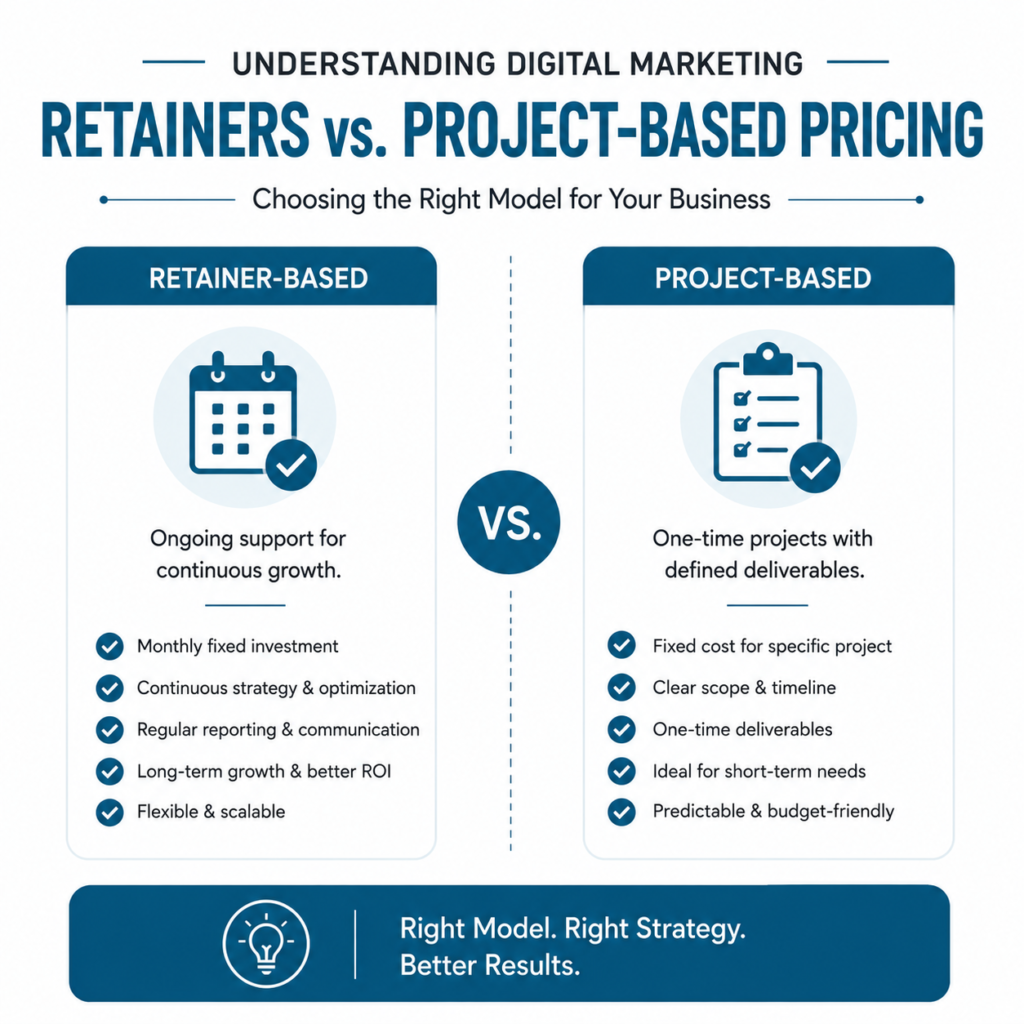
1. Introduction to Digital Marketing Pricing Models
Hiring a digital marketing agency involves more than selecting the right services—it also requires choosing the pricing model that best supports your business goals. The two most common engagement models are retainer-based services and project-based pricing.
Each model serves a different purpose. Understanding how they work helps businesses invest wisely, manage expectations, and maximize marketing performance.
2. What Is a Digital Marketing Retainer?
A digital marketing retainer is an ongoing agreement in which a business pays a fixed monthly fee for continuous marketing services.
Rather than completing a single task, the agency provides ongoing strategy, campaign management, optimization, reporting, and consultation. The relationship is long-term and focused on sustainable business growth.
Retainers allow agencies to continuously improve performance instead of restarting with every campaign.
3. What Is Project-Based Pricing?
Project-based pricing involves paying a fixed amount for a clearly defined service with a beginning and end.
Examples include:
- Website development
- SEO audits
- Brand identity design
- Landing page creation
- Marketing strategy documents
- Content creation packages
Once the agreed deliverables are completed, the project concludes unless additional work is requested.
4. Comparing Retainers and Projects
Although both pricing models provide professional marketing support, their objectives differ significantly.
A retainer emphasizes continuous improvement, optimization, and long-term business growth.
Project pricing focuses on completing a specific task within an agreed scope, budget, and timeline.
The right choice depends on whether your business needs ongoing marketing management or a one-time solution.
5. Benefits of Retainer-Based Services
Retainers offer consistent attention to every aspect of digital marketing.
Campaigns are monitored regularly, performance data is analyzed continuously, and improvements are implemented as market conditions evolve.
Because optimization never stops, businesses often experience stronger long-term returns and more predictable growth.
6. Advantages of Project-Based Pricing
Project pricing provides clarity and simplicity.
Businesses know exactly what they are purchasing, how much it will cost, and when the work will be completed.
This model is particularly suitable for organizations with limited budgets or clearly defined short-term objectives.
7. When a Retainer Is the Better Choice
Retainers are ideal when marketing requires continuous management.
Examples include:
- Search Engine Optimization
- Google Ads management
- Meta Ads campaigns
- Social media management
- Email marketing
- Content marketing
- Conversion optimization
These activities require regular adjustments to maintain performance.
8. When Project Pricing Makes Sense
Some marketing activities naturally fit a project-based structure.
Examples include:
- Website redesign
- Logo creation
- Brand guidelines
- Marketing audits
- Landing page development
- Video production
- Product photography
Once completed, these services typically require only occasional updates.
9. Cost Comparison
Project pricing usually involves a larger one-time payment.
Retainers distribute marketing investment into manageable monthly costs while providing continuous support.
Although retainers may appear more expensive initially, they often deliver greater long-term value through ongoing optimization and sustained business growth.
10. Flexibility and Scalability
Business priorities evolve over time.
Retainer agreements generally offer greater flexibility because campaigns can be expanded, adjusted, or redirected as new opportunities emerge.
Project-based services remain limited to the original scope unless a new agreement is established.
11. Performance Monitoring
Continuous monitoring distinguishes retainers from project engagements.
Monthly reporting enables agencies to evaluate campaign performance, identify trends, optimize advertising budgets, improve conversion rates, and refine audience targeting.
Project work typically concludes after delivery, leaving future optimization to the client or a subsequent engagement.
12. Communication Differences
Retainer relationships encourage ongoing collaboration.
Businesses typically receive weekly updates, monthly reports, strategic planning sessions, and continuous consultation.
Project communication generally revolves around milestones, approvals, revisions, and final delivery.
13. Resource Allocation
Retainer clients often benefit from access to an entire marketing team, including SEO specialists, paid advertising experts, designers, content writers, developers, and analysts.
Project clients usually engage specialists only for the duration of a specific assignment.
14. Risk and Return
Project-based pricing reduces financial commitment because businesses invest only when specific work is required.
Retainers involve a recurring investment but generally produce greater long-term returns through continuous improvement, proactive optimization, and sustained campaign management.
The level of investment should reflect the business’s growth objectives.
15. Service Examples
Retainer Services
- SEO
- Google Ads Management
- Meta Ads Management
- Social Media Management
- Content Marketing
- Email Marketing
- Analytics Reporting
Project-Based Services
- Website Development
- Brand Identity Design
- Marketing Audit
- Landing Page Design
- Video Production
- Brochure Design
- Product Photography
Understanding which services require ongoing attention helps businesses choose the appropriate pricing model.
16. Common Misconceptions
Many businesses believe retainers are unnecessarily expensive.
In reality, continuous optimization often reduces advertising waste and improves return on investment over time.
Likewise, project pricing is not always less expensive. Repeatedly hiring agencies for individual projects may ultimately exceed the cost of maintaining an ongoing strategic partnership.
17. Questions to Ask Before Choosing
Before selecting a pricing model, consider the following:
- Are your marketing needs ongoing or temporary?
- What are your long-term business goals?
- What marketing budget is available?
- How quickly do you expect results?
- Do campaigns require continuous optimization?
- Will future marketing activities expand?
Answering these questions provides valuable decision-making clarity.
18. Hybrid Pricing Models
Many businesses benefit from combining both service models.
For example, a company may commission a website redesign as a one-time project and subsequently retain the agency for SEO, paid advertising, and social media management.
Hybrid models offer flexibility while maintaining long-term strategic support.
19. Choosing the Best Model for Your Business
Startups often begin with project-based services to establish their online presence.
Growing businesses typically transition toward retainers as marketing activities become more sophisticated.
Large organizations frequently combine both models, using retainers for ongoing campaigns and projects for specialized initiatives.
The optimal choice depends on business size, objectives, budget, and growth strategy.
20. Conclusion
Both retainer-based services and project-based pricing play valuable roles in digital marketing. Neither model is universally superior; each serves different business requirements.
Project pricing delivers clearly defined outcomes for specific objectives, while retainers provide continuous optimization, strategic guidance, and sustainable long-term growth.
By carefully evaluating your marketing goals, available resources, and future expansion plans, you can select the service model that delivers the greatest value and positions your business for lasting success. The right pricing structure is not simply about cost—it is about building a marketing partnership that supports measurable growth, stronger customer engagement, and ongoing competitive advantage.