
1. Introduction: Why Customer Growth Matters
Every business depends on a steady flow of customers to grow. Whether operating a retail store, restaurant, clinic, showroom, or service-based company, attracting new visitors while retaining existing customers is essential for long-term success.
Digital marketing agencies help businesses achieve this by combining data, technology, creativity, and strategic planning. Their objective is not simply to increase visibility—it is to bring the right customers at the right time.
2. Understanding Business Footfall
Footfall refers to the number of people who visit a physical store or business location. In today’s digital landscape, customer journeys often begin online before leading to offline visits.
An effective marketing strategy increases website traffic, phone inquiries, online bookings, and ultimately physical store visits by guiding potential customers through every stage of the buying journey.
3. Building a Strong Brand Presence
Customers are more likely to choose brands they recognize and trust.
Agencies create consistent branding across websites, search engines, social media platforms, advertisements, and business listings. Consistent messaging strengthens credibility and improves customer recall.
A recognizable brand naturally attracts more inquiries and repeat customers.
4. Identifying the Right Target Audience
Successful marketing begins with understanding who the ideal customers are.
Digital marketing agencies analyze demographics, interests, purchasing behavior, online activity, and geographic locations to build detailed customer profiles.
Instead of advertising to everyone, campaigns focus on audiences most likely to convert into paying customers.
5. Search Engine Optimization (SEO)
SEO improves a business’s visibility when customers search online for products or services.
Optimized websites rank higher on search engines, generating consistent organic traffic without paying for every click.
For local businesses, Local SEO helps customers discover nearby stores, clinics, restaurants, and service providers when searching for solutions in their area.
6. Google Business Profile Optimization
A well-optimized Google Business Profile increases visibility in local search results and Google Maps.
Agencies update business information, manage photographs, encourage customer reviews, respond to feedback, and optimize service categories.
This makes it easier for nearby customers to locate, contact, and visit the business.
7. Paid Advertising Campaigns
Paid advertising provides immediate visibility.
Google Ads connect businesses with customers actively searching for products and services, while Meta Ads introduce brands to audiences based on interests, behaviors, and demographics.
Well-managed campaigns increase inquiries, appointments, purchases, and store visits while maintaining measurable return on investment.
8. Social Media Marketing
Social media platforms create daily opportunities to engage with customers.
Agencies publish educational content, promotional offers, customer testimonials, behind-the-scenes videos, and interactive posts that encourage conversations.
Consistent engagement builds familiarity, trust, and brand loyalty, ultimately increasing customer visits.
9. Content Marketing
Content educates before it sells.
Blogs, videos, FAQs, infographics, buying guides, and success stories answer customer questions while demonstrating expertise.
Useful content positions businesses as trusted authorities, making customers more confident in choosing their products or services.
10. Local Marketing Strategies
Local marketing focuses on attracting customers within a specific geographic area.
Agencies implement location-based advertising, local SEO, neighborhood campaigns, event promotions, and community partnerships to increase nearby awareness.
This targeted approach generates highly relevant traffic and improves local footfall.
11. Website Optimization
A business website should encourage visitors to take action.
Agencies improve page speed, mobile responsiveness, navigation, calls-to-action, contact forms, and booking systems to create a seamless user experience.
An optimized website converts more visitors into customers.
12. Conversion Rate Optimization (CRO)
Attracting visitors is only part of the process.
Conversion Rate Optimization focuses on turning website visitors into leads, appointments, purchases, or store visits.
Through A/B testing, improved landing pages, stronger calls-to-action, and simplified customer journeys, agencies increase conversion rates without necessarily increasing advertising spend.
13. Online Reviews and Reputation Management
Customer reviews significantly influence purchasing decisions.
Agencies encourage satisfied customers to leave positive reviews while responding professionally to negative feedback.
A strong online reputation builds trust and encourages more people to choose the business.
14. Email and WhatsApp Marketing
Existing customers often represent the most valuable growth opportunity.
Agencies use email newsletters and WhatsApp campaigns to announce new products, special offers, seasonal discounts, and business updates.
Regular communication encourages repeat purchases and increases customer lifetime value.
15. Remarketing Campaigns
Not every visitor makes an immediate purchase.
Remarketing campaigns reconnect with people who previously visited the website or interacted with advertisements.
By reminding potential customers about products or services they already considered, agencies significantly improve conversion rates.
16. Seasonal and Promotional Campaigns
Consumer behavior changes throughout the year.
Agencies develop campaigns around festivals, holidays, business anniversaries, product launches, clearance sales, and limited-time promotions.
Seasonal campaigns generate urgency while attracting increased customer attention.
17. Performance Tracking and Analytics
Every marketing activity should produce measurable insights.
Agencies monitor website traffic, customer inquiries, advertisement performance, conversion rates, and revenue growth using analytics tools.
Regular reporting enables continuous optimization and smarter marketing decisions.
18. Creating Long-Term Customer Relationships
Acquiring new customers is important, but retaining them is even more valuable.
Agencies help businesses implement loyalty programs, personalized communication, referral campaigns, and exclusive offers that encourage repeat visits.
Long-term relationships contribute to sustainable business growth.
19. Why Businesses Partner with Agencies
Digital marketing agencies bring specialized expertise, creative resources, advanced tools, and industry experience that many businesses cannot maintain internally.
They continuously monitor trends, optimize campaigns, test new ideas, and adapt strategies to changing customer behavior.
This allows business owners to focus on operations while professionals manage growth initiatives.
20. Conclusion
Bringing more customers through the door requires far more than advertising alone. It involves understanding customer behavior, building trust, increasing visibility, optimizing digital experiences, and continuously refining marketing strategies.
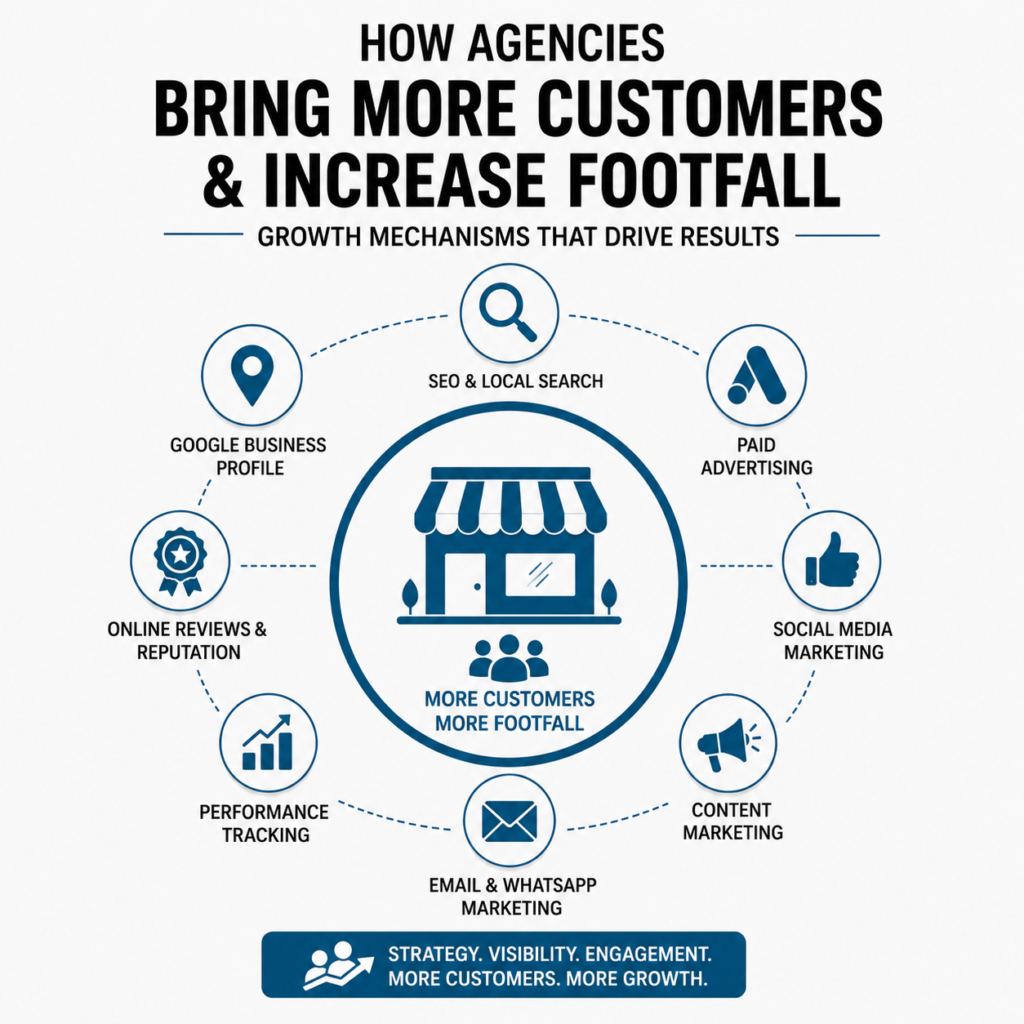
Digital marketing agencies achieve this by combining SEO, paid advertising, social media, content marketing, local optimization, reputation management, analytics, and customer engagement into a unified growth strategy.
When these growth mechanisms work together, businesses experience more qualified leads, stronger brand recognition, increased customer footfall, higher sales, and sustainable long-term success. Rather than simply promoting products or services, agencies create measurable systems that consistently attract, engage, and convert customers into loyal advocates.