
Introduction: Why Agency Optimization Matters
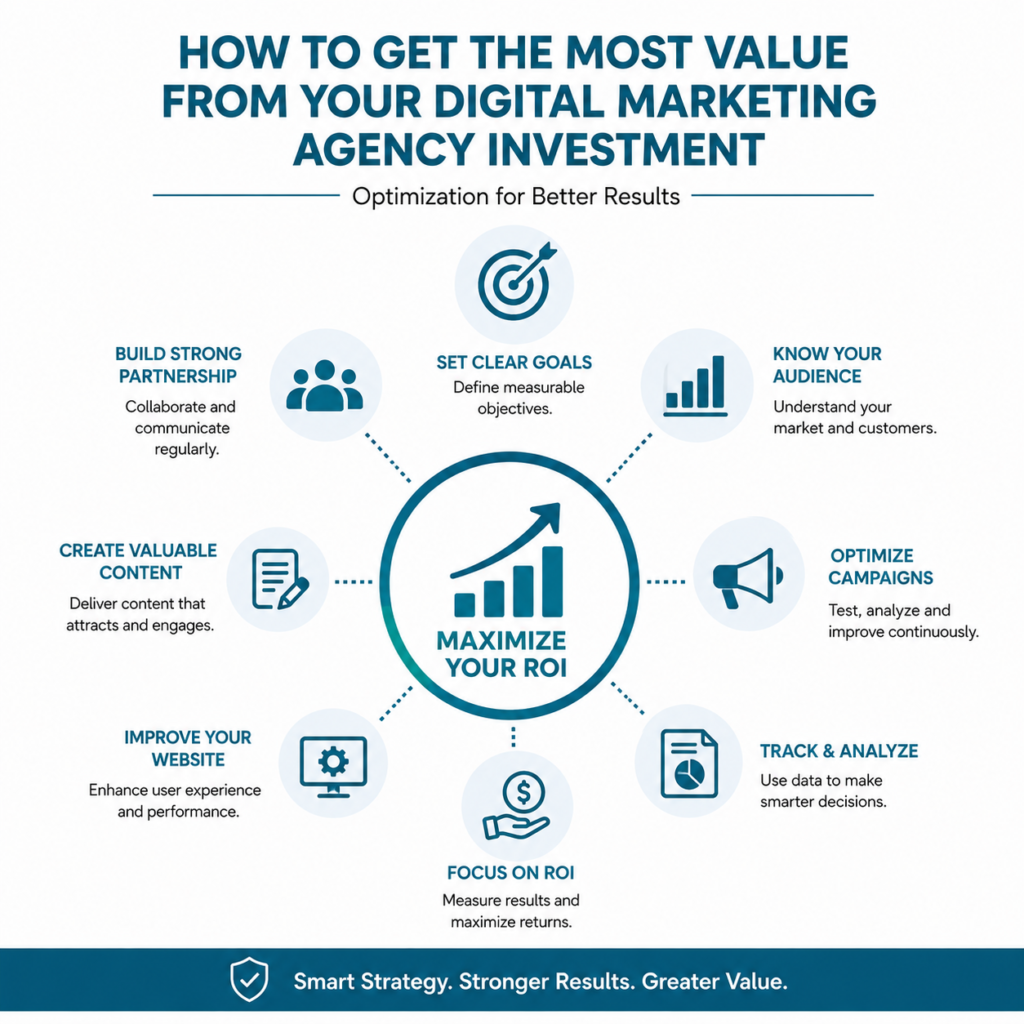
Hiring a digital marketing agency is more than outsourcing promotional activities—it is a strategic investment in business growth. The true value of that investment depends not only on the agency’s expertise but also on how effectively the partnership is managed.
Businesses that actively collaborate with their agencies often experience stronger brand visibility, higher-quality leads, improved customer engagement, and greater long-term returns. Optimization is about making every marketing dollar work harder.
2. Defining Clear Business Objectives
Every successful marketing campaign begins with a clearly defined objective.
Whether the goal is increasing website traffic, generating qualified leads, boosting online sales, or strengthening brand awareness, the agency must understand exactly what success looks like.
Specific and measurable goals provide direction, improve accountability, and simplify performance evaluation.
3. Choosing the Right Digital Marketing Agency
Not every agency is the right fit for every business.
Evaluate potential agencies based on industry experience, service capabilities, proven results, communication style, and client testimonials. An agency that understands your market can develop more relevant strategies and avoid unnecessary trial and error.
Selecting the right partner is the first optimization step.
4. Building a Strong Partnership
The best results come from collaboration rather than delegation.
Treat your agency as an extension of your internal team. Share business updates, discuss challenges, celebrate milestones, and involve them in strategic planning.
Trust and transparency encourage better ideas and stronger outcomes.
5. Creating a Realistic Marketing Budget
Marketing should be viewed as an ongoing investment rather than a one-time expense.
A well-planned budget allows campaigns to mature, gather meaningful data, and improve through continuous optimization. Allocate resources across SEO, paid advertising, content creation, social media, and analytics based on your business priorities.
Consistency often outperforms sporadic spending.
6. Sharing Complete Business Information
Agencies make better decisions when they fully understand your business.
Provide detailed information about your products, services, target audience, competitive landscape, unique selling propositions, and previous marketing efforts.
The more context they receive, the more precise and effective their campaigns become.
7. Establishing Clear Communication
Frequent communication prevents misunderstandings and keeps campaigns aligned with business objectives.
Schedule weekly progress discussions, monthly performance reviews, and quarterly strategy sessions. Encourage open conversations about successes, challenges, and opportunities for improvement.
Strong communication strengthens accountability.
8. Defining Key Performance Indicators (KPIs)
Performance cannot improve if it is not measured.
Track meaningful KPIs such as:
- Website traffic
- Organic keyword rankings
- Qualified leads
- Conversion rates
- Cost per lead
- Customer acquisition cost
- Return on advertising spend
- Revenue generated
These metrics provide a clear picture of campaign effectiveness.
9. Leveraging SEO for Long-Term Growth
Search Engine Optimization creates sustainable business growth by attracting qualified organic traffic.
Invest in keyword research, technical improvements, content optimization, high-quality backlinks, and local SEO initiatives.
Unlike paid advertising, SEO continues delivering value long after content has been published.
10. Maximizing Paid Advertising Performance
Paid advertising generates immediate visibility when managed effectively.
Regular optimization includes refining audience targeting, testing creatives, improving landing pages, adjusting bidding strategies, and monitoring campaign performance.
Continuous optimization reduces wasted spend while increasing conversions.
11. Optimizing Content Marketing
Content builds trust before it generates sales.
Publish educational blogs, guides, videos, FAQs, case studies, and customer success stories that answer real customer questions.
High-quality content strengthens SEO, nurtures leads, and establishes long-term authority within your industry.
12. Strengthening Social Media Marketing
Social media is more than posting updates.
Create engaging conversations, respond to customer inquiries, share valuable insights, and showcase your brand personality.
Consistent interaction builds stronger customer relationships and increases brand loyalty.
13. Improving Website Performance
Your website should convert visitors into customers.
Optimize loading speed, mobile responsiveness, navigation, calls-to-action, forms, and overall user experience.
A high-performing website amplifies the effectiveness of every marketing campaign.
14. Using Data to Drive Decisions
Successful agencies rely on evidence rather than assumptions.
Analyze user behavior, traffic sources, conversion paths, campaign performance, and customer demographics.
Data-driven decisions eliminate guesswork and improve marketing efficiency.
15. Continuous Campaign Testing
Marketing optimization is an ongoing process.
Test different headlines, visuals, audience segments, landing pages, and calls-to-action through A/B testing.
Small improvements accumulated over time often produce substantial gains in overall performance.
16. Investing in Marketing Automation
Automation improves efficiency without sacrificing personalization.
Implement automated email sequences, lead nurturing campaigns, CRM integrations, and customer follow-up workflows.
Automation allows businesses to engage customers consistently while reducing manual effort.
17. Encouraging Innovation and Experimentation
Digital marketing evolves continuously.
Encourage your agency to explore emerging platforms, creative formats, AI-powered tools, interactive content, and innovative campaign ideas.
Calculated experimentation often uncovers valuable growth opportunities.
18. Measuring Return on Investment
Every marketing investment should contribute to measurable business growth.
Evaluate campaign success using metrics such as:
- Return on Investment (ROI)
- Return on Advertising Spend (ROAS)
- Customer Lifetime Value (CLV)
- Customer Acquisition Cost (CAC)
These measurements reveal where future investments should be concentrated.
19. Avoiding Common Mistakes
Several common mistakes reduce marketing effectiveness.
Expecting overnight success, constantly changing strategy, withholding business information, focusing only on short-term sales, and micromanaging every campaign can hinder performance.
Successful marketing requires patience, collaboration, and strategic consistency.
20. Conclusion
Maximizing the value of your digital marketing agency investment requires more than hiring experienced professionals. It demands clear objectives, transparent communication, continuous optimization, data-driven decision-making, and a long-term commitment to growth.
Businesses that actively collaborate with their agencies, embrace continuous improvement, and measure meaningful outcomes consistently achieve stronger returns on investment.
Optimization is not a one-time activity—it is an ongoing process that transforms marketing expenses into sustainable business growth. By refining strategies, leveraging data, and building a trusted agency partnership, every marketing investment can deliver greater visibility, stronger customer relationships, and long-term competitive advantage.