
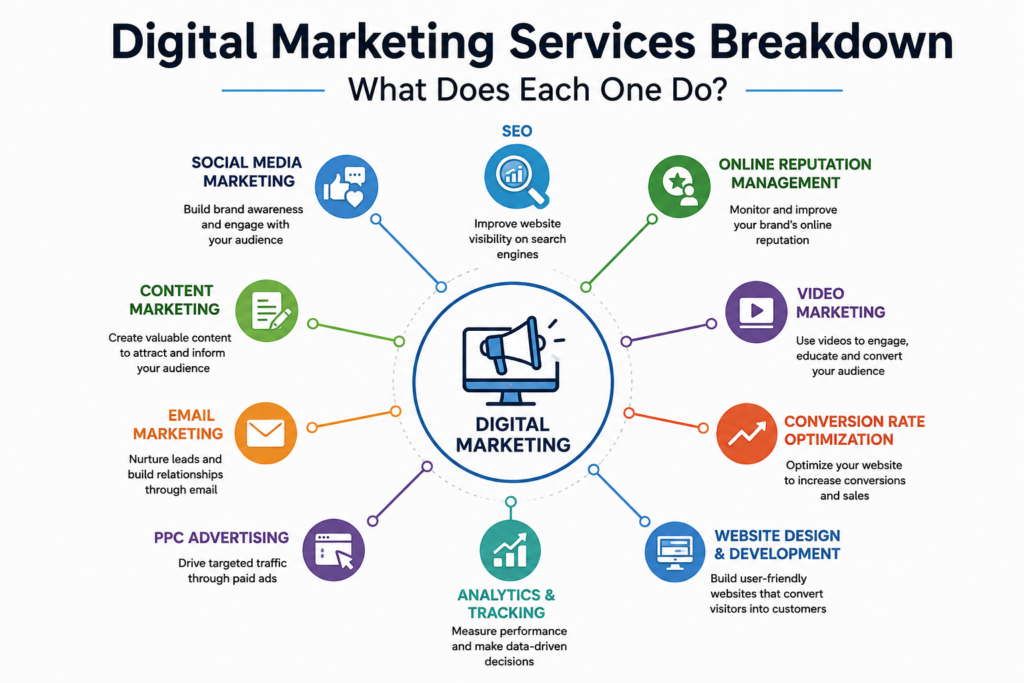
Introduction to Digital Marketing Services
Digital marketing encompasses every online activity used to promote products, services, and brands. Instead of relying solely on traditional advertising methods, businesses now utilize search engines, websites, social media platforms, email, video, and paid advertisements to reach potential customers.
Each digital marketing service performs a distinct function. Some attract new visitors, others nurture relationships, while certain services focus on converting interested prospects into loyal customers. Understanding these individual components enables businesses to invest more strategically.
Understanding the Digital Marketing Ecosystem
Digital marketing functions as an interconnected ecosystem rather than a collection of isolated services.
A customer may first discover a business through Google Search, explore its website, follow its social media pages, subscribe to an email newsletter, and eventually complete a purchase after viewing a remarketing advertisement.
The strongest marketing strategies combine multiple services that support one another throughout the customer journey.
Search Engine Optimization (SEO)
SEO improves a website’s visibility within search engine results without relying on paid advertisements.
On-Page SEO
Optimizes titles, headings, keywords, images, URLs, and internal links to improve relevance.
Off-Page SEO
Builds website authority through backlinks, brand mentions, and digital PR activities.
Technical SEO
Improves website speed, crawlability, indexing, mobile usability, structured data, and security.
Local SEO
Optimizes business listings, Google Business Profile, local citations, and customer reviews to attract nearby customers.
SEO creates sustainable organic traffic and long-term online visibility.
Search Engine Marketing (SEM)
SEM focuses on paid advertising within search engines.
Businesses bid on keywords so their advertisements appear above organic search results. Campaigns can generate immediate visibility while allowing advertisers to control budgets, locations, devices, and audience targeting.
SEM is especially valuable for competitive industries and time-sensitive campaigns.
Social Media Marketing (SMM)
Social media marketing strengthens brand awareness and customer relationships.
Organic marketing involves creating engaging posts, videos, stories, polls, and educational content.
Paid social campaigns target highly specific audiences based on demographics, interests, online behavior, and purchasing intent.
Community management further enhances customer trust by responding to comments, questions, and messages promptly.
Content Marketing
Content marketing educates audiences while establishing industry authority.
Businesses publish blogs, articles, guides, whitepapers, eBooks, infographics, FAQs, and case studies that answer customer questions.
High-quality content improves SEO, nurtures trust, generates backlinks, and supports lead generation over an extended period.
Email Marketing
Email remains one of the highest-return digital marketing channels.
Businesses use newsletters to share updates, promotional campaigns to increase sales, and automated workflows to nurture leads throughout the buying process.
Segmentation and personalization significantly improve engagement and conversion rates.
Pay-Per-Click (PPC) Advertising
PPC enables businesses to pay only when someone clicks their advertisement.
Search campaigns capture users actively searching for products or services.
Display campaigns increase visibility across websites.
Remarketing campaigns reconnect with visitors who previously interacted with a website but did not convert.
PPC delivers measurable and scalable results when properly optimized.
Display Advertising
Display advertising uses visual banner ads placed across millions of websites and mobile applications.
These advertisements enhance brand recognition, support product launches, and maintain visibility throughout the customer journey.
Responsive display ads automatically adjust their format to fit various screen sizes and placements.
Video Marketing
Video has become one of the most engaging forms of digital communication.
Businesses produce explainer videos, product demonstrations, testimonials, educational tutorials, behind-the-scenes content, and short-form social videos.
Video effectively captures attention while simplifying complex information.
Influencer Marketing
Influencer marketing leverages trusted creators who already possess engaged audiences.
Micro-influencers often generate stronger engagement within niche markets, while macro-influencers provide extensive reach for broader campaigns.
Authenticity remains the key to successful influencer partnerships.
Affiliate Marketing
Affiliate marketing rewards third-party partners for generating sales or qualified leads.
Affiliates promote products using blogs, websites, videos, and social media channels.
Businesses pay commissions only when predefined actions occur, making affiliate marketing a highly performance-oriented strategy.
Conversion Rate Optimization (CRO)
Driving traffic alone is insufficient.
CRO focuses on increasing the percentage of visitors who complete desired actions such as purchases, inquiries, or registrations.
Landing page improvements, simplified forms, persuasive calls-to-action, user behavior analysis, and A/B testing collectively enhance conversion performance.
Website Design and Development
A website serves as the digital headquarters of a business.
Modern websites prioritize responsive design, intuitive navigation, rapid loading speeds, secure browsing, accessibility, and conversion-focused layouts.
A professionally designed website strengthens credibility while supporting every other marketing initiative.
Online Reputation Management (ORM)
Brand perception significantly influences purchasing decisions.
ORM involves monitoring online reviews, responding professionally to customer feedback, encouraging positive testimonials, and addressing negative experiences before they escalate.
A strong reputation builds trust and long-term customer loyalty.
Marketing Automation
Marketing automation streamlines repetitive activities.
Businesses automate email campaigns, lead nurturing sequences, CRM updates, customer segmentation, follow-up reminders, and personalized communication.
Automation increases efficiency while maintaining consistent customer engagement.
Analytics and Performance Tracking
Effective marketing depends on measurable data.
Analytics platforms monitor website traffic, conversions, engagement, advertising performance, customer acquisition costs, and return on investment.
These insights enable continuous optimization and informed decision-making.
Mobile Marketing
Most digital interactions now occur on mobile devices.
Mobile marketing includes responsive websites, SMS campaigns, push notifications, location-based advertising, and mobile application promotion.
Delivering seamless mobile experiences improves customer satisfaction and engagement.
Choosing the Right Services for Your Business
Not every organization requires every digital marketing service simultaneously.
A startup may prioritize website development, SEO, and social media. An e-commerce business may invest heavily in PPC, email marketing, and conversion optimization. A local business often benefits from Local SEO and Google Business Profile optimization.
Selecting services should always align with business objectives, target audiences, available resources, and growth ambitions.
Conclusion
Digital marketing is not a single service but a coordinated collection of specialized disciplines that work together to drive business growth.
SEO improves discoverability. PPC generates immediate traffic. Social media builds engagement. Content establishes authority. Email nurtures relationships. Analytics guide informed decisions. Conversion optimization transforms visitors into customers.
Understanding the purpose of each service enables businesses to allocate marketing budgets wisely, build integrated campaigns, and create sustainable long-term growth. Rather than viewing these services independently, organizations should recognize them as complementary components of a comprehensive digital marketing strategy that delivers measurable results and lasting competitive advantage.