Introduction:
The Power of Digital Advertising
Digital advertising has transformed the way businesses attract, engage, and convert customers. In today’s highly competitive marketplace, simply having a website or social media presence is no longer sufficient. Companies must actively reach potential customers where they spend their time online.
This is where Meta Ads and Google Ads become indispensable. Together, these platforms provide businesses with unprecedented opportunities to increase visibility, generate leads, drive sales, and accelerate growth. However, unlocking their full potential requires specialized knowledge, strategic planning, and continuous optimization. Professional agencies bring this platform expertise to help businesses achieve measurable success.
Understanding Meta Ads and Google Ads
What Are Meta Ads?
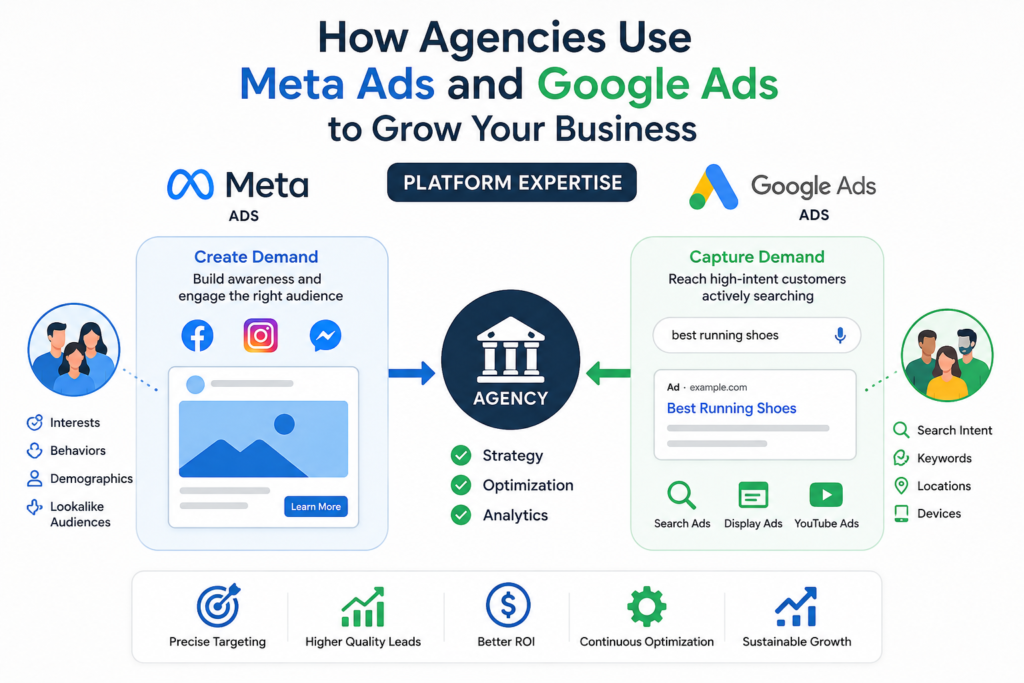
Meta Ads encompass advertising across Facebook, Instagram, Messenger, and the Meta Audience Network. These platforms enable businesses to connect with highly specific audiences based on demographics, interests, behaviors, and online activities.
Meta excels at creating demand. Users may not be actively searching for a product, yet compelling advertisements can capture attention and inspire action. This makes Meta particularly effective for brand awareness, engagement, and customer acquisition.
What Are Google Ads?
Google Ads is a powerful advertising ecosystem that includes Search Ads, Display Ads, YouTube Ads, Shopping Ads, and Performance Max campaigns.
Unlike social media advertising, Google targets users who are already searching for products, services, or solutions. This intent-driven approach often leads to higher conversion rates because the audience is actively seeking information or making purchasing decisions.
Why Businesses Need Platform Expertise
The Complexity of Modern Advertising
Both Meta Ads and Google Ads have evolved into sophisticated advertising ecosystems. Advertisers must understand bidding strategies, audience segmentation, campaign objectives, attribution models, creative formats, and conversion tracking.
A single misconfiguration can significantly impact campaign performance. Agencies possess the expertise needed to navigate these complexities efficiently.
The Cost of Inexperience
Many businesses launch campaigns without proper strategy. They select broad audiences, create ineffective advertisements, or neglect optimization.
The result is wasted budget, poor engagement, and disappointing returns. Platform expertise helps eliminate these inefficiencies while maximizing advertising investments.
How Agencies Build Winning Advertising Strategies
Market Research and Audience Analysis
Successful campaigns begin with thorough research. Agencies analyze market conditions, customer demographics, purchasing behaviors, and industry trends.
This process helps identify the most valuable audience segments and uncovers opportunities for growth.
Competitor Intelligence
Agencies also evaluate competitors’ advertising activities. By studying messaging, offers, creative approaches, and targeting strategies, they can identify market gaps and develop stronger positioning for their clients.
Competitive intelligence provides a strategic advantage in crowded marketplaces.
Meta Ads: Creating Demand and Brand Awareness
Audience Targeting Capabilities
Meta’s targeting capabilities are exceptionally robust. Agencies can build audiences based on age, location, interests, purchasing behavior, device usage, and engagement history.
Advanced techniques such as Lookalike Audiences allow businesses to reach new prospects who resemble existing customers.
Creative-Driven Advertising
Success on Meta often depends on compelling creative assets. Agencies design eye-catching visuals, persuasive copy, engaging videos, and interactive content that resonates with target audiences.
Strong creative execution transforms passive scrolling into meaningful customer engagement.
Google Ads: Capturing High-Intent Customers
Search Advertising
Google Search Ads place businesses directly in front of users actively searching for solutions. Agencies conduct extensive keyword research to identify high-intent search terms that generate qualified traffic.
This approach helps businesses connect with prospects at critical decision-making moments.
Display and Video Advertising
Google’s Display Network and YouTube advertising provide additional opportunities for brand exposure. Agencies create strategic campaigns that reinforce brand awareness and nurture prospects throughout the customer journey.
These formats help businesses maintain visibility beyond traditional search results.
Audience Segmentation and Targeting Techniques
Demographic Targeting
Effective advertising requires precision. Agencies segment audiences based on factors such as age, gender, location, income, education, and occupation.
This level of granularity improves relevance and campaign performance.
Behavioral Targeting
Behavioral targeting focuses on user actions and interests. Agencies analyze browsing habits, purchasing behavior, content consumption, and engagement patterns.
These insights enable highly personalized advertising experiences.
Remarketing Strategies
Remarketing targets individuals who have previously interacted with a business. Agencies create tailored campaigns that encourage returning visitors to complete purchases, submit inquiries, or engage further.
Remarketing frequently delivers some of the highest conversion rates in digital advertising.
Data-Driven Campaign Optimization
Performance Monitoring
Advertising success requires constant vigilance. Agencies continuously monitor key performance indicators including impressions, clicks, conversions, cost-per-click, and return on ad spend.
This ongoing analysis enables rapid identification of opportunities and challenges.
A/B Testing and Experimentation
Agencies systematically test headlines, images, videos, calls-to-action, landing pages, and audience segments.
Even minor improvements can produce substantial gains in campaign effectiveness. Continuous experimentation fosters sustainable performance growth.
Conversion Tracking and Analytics
Measuring Real Business Results
Clicks and impressions are valuable metrics, but conversions ultimately determine success. Agencies implement tracking systems that measure leads, sales, phone calls, form submissions, and revenue.
This provides a clear understanding of advertising impact.
Attribution and Customer Journey Analysis
Modern customers interact with multiple touchpoints before converting. Agencies utilize attribution models to understand how various channels contribute to conversions.
This comprehensive perspective supports better decision-making and budget allocation.
Budget Management and Return on Investment
Smart Budget Allocation
Professional agencies strategically distribute budgets across campaigns, audiences, and platforms.
Rather than relying on assumptions, they use performance data to direct spending toward the highest-performing opportunities.
Reducing Wasted Ad Spend
One of the greatest benefits of platform expertise is efficiency. Agencies identify underperforming keywords, ineffective audiences, and low-converting placements.
Eliminating waste increases profitability and improves overall campaign performance.
Scaling Campaigns for Sustainable Growth
Expanding Reach
Once campaigns demonstrate success, agencies gradually scale advertising efforts. They expand audience reach, explore new markets, and introduce additional campaign formats.
This controlled expansion minimizes risk while maximizing growth potential.
Increasing Revenue Efficiently
Scaling is not merely about spending more money. Agencies focus on maintaining profitability while increasing volume.
Sophisticated optimization techniques ensure growth remains sustainable and financially viable.
Common Mistakes Businesses Make Without Agency Support
Many businesses encounter recurring challenges when managing advertising independently:
- Targeting audiences that are too broad.
- Selecting incorrect campaign objectives.
- Neglecting conversion tracking.
- Using weak creative assets.
- Ignoring campaign optimization.
- Misallocating advertising budgets.
- Failing to analyze performance data.
These mistakes can significantly reduce advertising effectiveness and increase costs.
The Future of Meta Ads and Google Ads
Artificial intelligence, machine learning, automation, and predictive analytics continue to reshape digital advertising.
Meta and Google are introducing increasingly sophisticated tools that enhance targeting, bidding, and campaign management. Agencies remain at the forefront of these developments, helping businesses adapt to emerging technologies and maintain competitive advantages.
Organizations that embrace innovation will be better positioned to thrive in the evolving digital landscape.
Conclusion: Why Platform Expertise Matters
Meta Ads and Google Ads have become essential growth engines for modern businesses. While the platforms offer tremendous opportunities, achieving exceptional results requires more than simply launching campaigns.
Professional agencies provide the strategic insight, technical proficiency, analytical expertise, and creative excellence necessary to maximize advertising performance. Through precise targeting, continuous optimization, advanced analytics, and efficient budget management, agencies help businesses transform advertising investments into measurable growth.
In an increasingly competitive marketplace, platform expertise is not merely an advantage—it is a critical component of long-term business success.