
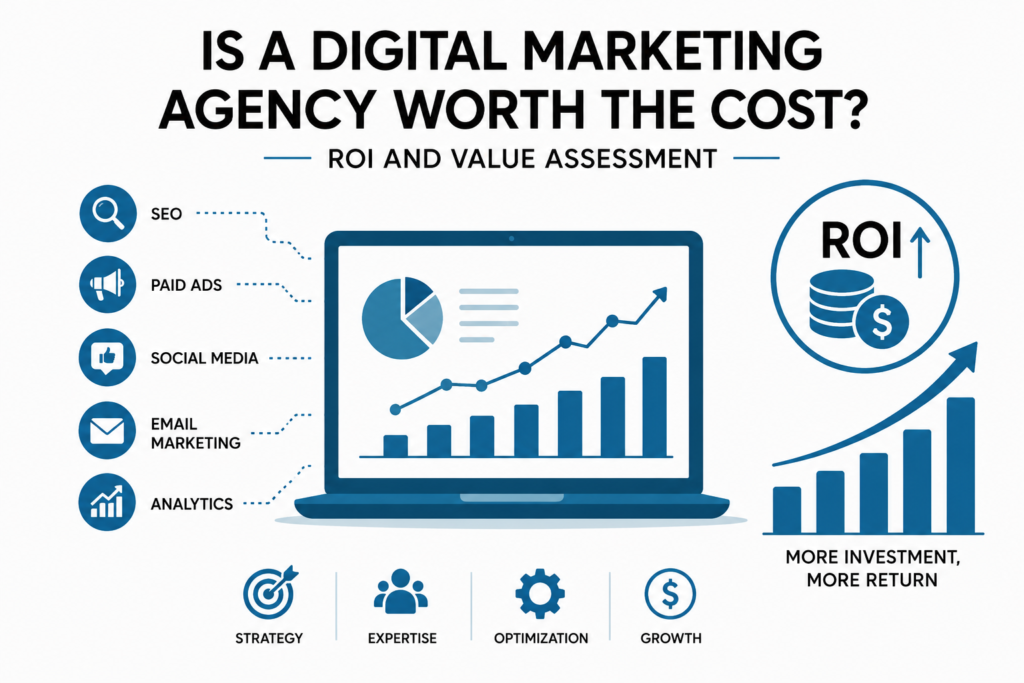
Introduction: Understanding the Real Cost of Digital Marketing.
Every business reaches a stage where growth becomes difficult without effective marketing. Whether the goal is generating leads, increasing website traffic, building brand awareness, or driving online sales, digital marketing plays a decisive role. The challenge is determining whether hiring a digital marketing agency is a worthwhile investment or simply another business expense.
The answer depends on one critical factor: return on investment. A good agency should not merely create advertisements or social media posts. It should produce measurable business growth that exceeds the money invested.
Understanding this distinction is essential before making any marketing decision.
What Does a Digital Marketing Agency Actually Do?
A digital marketing agency manages numerous online marketing activities under one strategic framework.
Typical services include:
- Search Engine Optimization (SEO)
- Google Ads Management
- Meta (Facebook & Instagram) Advertising
- Social Media Management
- Content Marketing
- Website Optimization
- Email Marketing
- Conversion Rate Optimization
- Analytics Reporting
- Brand Positioning
Rather than working independently, these services operate collectively to improve customer acquisition and revenue generation.
Why Businesses Invest in Marketing Agencies
Businesses hire agencies because digital marketing has become increasingly sophisticated.
Algorithms evolve constantly.
Consumer behavior changes.
Competition intensifies.
Maintaining expertise across multiple platforms internally requires significant time and resources.
Professional agencies remain updated with industry developments while businesses focus on their primary operations.
This specialization often produces superior results.
Understanding Marketing ROI
What Is ROI?
Return on Investment measures the profitability generated from marketing expenditures.
The formula is straightforward:
ROI = (Revenue Generated – Marketing Cost) ÷ Marketing Cost × 100
A positive ROI indicates that marketing efforts are generating more revenue than they cost.
Why ROI Matters
Marketing should never be evaluated solely by the number of likes, followers, or impressions.
The true indicators include:
- Revenue growth
- Qualified leads
- Customer acquisition
- Sales conversions
- Profit margins
- Customer retention
These metrics reveal the genuine financial impact of marketing activities.
Cost of Hiring a Digital Marketing Agency
Agency pricing varies according to scope and expertise.
Monthly Retainers
Ideal for businesses requiring continuous marketing support.
Services generally include:
- SEO
- Social media management
- Paid advertising
- Reporting
- Strategy refinement
This model offers long-term consistency.
Project-Based Pricing
Suitable for businesses needing specific deliverables such as:
- Website redesign
- Brand launch
- SEO audit
- Marketing campaign
- Content development
Costs remain predictable and well-defined.
Performance-Based Pricing
Some agencies tie compensation to measurable outcomes such as:
- Leads
- Sales
- Revenue
- Qualified appointments
Although attractive, businesses should carefully review performance definitions and tracking methodologies.
Comparing DIY Marketing vs Agency Marketing
Managing marketing internally may appear economical initially.
However, hidden limitations frequently emerge:
DIY Marketing:
- Limited expertise
- Restricted resources
- Slow learning curve
- Higher probability of mistakes
Agency Marketing:
- Experienced professionals
- Established systems
- Advanced tools
- Faster execution
- Continuous optimization
The efficiency gained often compensates for agency fees.
Hidden Costs of Managing Marketing In-House
Internal marketing involves expenses beyond employee salaries.
Additional costs include:
- Marketing software subscriptions
- Training programs
- Recruitment
- Employee turnover
- Design tools
- Analytics platforms
- Advertising certifications
- Opportunity costs
These expenditures accumulate rapidly.
Key Benefits of Hiring a Digital Marketing Agency
Professional agencies provide comprehensive advantages:
- Strategic planning
- Multi-channel execution
- Experienced specialists
- Continuous optimization
- Scalable campaigns
- Transparent reporting
These capabilities improve overall marketing performance.
Expertise Across Multiple Marketing Channels
Consumers interact with brands across various digital platforms.
Agencies coordinate:
SEO drives organic traffic.
Google Ads captures high-intent searches.
Social media builds awareness.
Email nurtures prospects.
Remarketing recovers abandoned customers.
This integrated methodology enhances campaign effectiveness.
Access to Premium Marketing Tools
Professional agencies invest heavily in enterprise-grade platforms.
Examples include:
- Keyword research software
- Competitor intelligence tools
- Heatmap analytics
- Conversion tracking
- Automation platforms
- AI-powered reporting systems
Businesses benefit without purchasing each platform independently.
Data-Driven Decision Making
Modern marketing relies on analytics rather than assumptions.
Agencies monitor:
- Website traffic
- Bounce rates
- Conversion rates
- Cost per click
- Return on ad spend
- Customer behavior
- Funnel performance
This evidence-based approach minimizes guesswork.
Time Savings and Operational Efficiency
Business owners already manage numerous responsibilities.
Marketing demands continuous attention.
Delegating campaigns enables leadership teams to concentrate on:
- Product development
- Customer service
- Operations
- Strategic expansion
Time itself becomes a valuable return on investment.
Better Lead Generation Strategies
Generating leads requires more than advertising.
Successful agencies optimize every stage of the customer journey:
Awareness.
Interest.
Consideration.
Decision.
Conversion.
Retention.
Each stage receives deliberate attention.
Improving Customer Acquisition Cost (CAC)
Customer Acquisition Cost measures the expense required to acquire one customer.
Agencies reduce CAC by:
- Improving audience targeting
- Eliminating ineffective advertisements
- Optimizing landing pages
- Refining bidding strategies
- Increasing conversion rates
Lower acquisition costs improve profitability.
Increasing Customer Lifetime Value (CLV)
Marketing should prioritize long-term customer relationships.
Agencies implement:
- Email automation
- Loyalty campaigns
- Remarketing
- Personalized content
- Customer engagement strategies
Retaining existing customers is often more cost-effective than acquiring new ones.
Measuring Marketing Performance
Effective agencies provide transparent reporting.
Key metrics include:
- Revenue generated
- Return on ad spend (ROAS)
- Cost per lead
- Conversion rate
- Organic traffic
- Keyword rankings
- Engagement metrics
- Sales pipeline growth
Consistent measurement enables informed decision-making.
Industries That Benefit Most from Digital Marketing Agencies
Several industries consistently achieve substantial returns:
- E-commerce
- Healthcare
- Real estate
- Education
- Manufacturing
- SaaS
- Hospitality
- Professional services
- Automotive
- Home improvement
These sectors rely heavily on digital customer acquisition.
When Hiring an Agency May Not Be Worth It
Not every business requires agency support immediately.
Hiring may be premature when:
- Marketing budgets are extremely limited.
- Business objectives are undefined.
- Products are not market-ready.
- Internal processes cannot handle increased demand.
Preparation is essential before scaling marketing investments.
How to Calculate the ROI of an Agency
A practical example:
Agency Investment: RS 3,000 per month
Generated Revenue: Rs15,000
Net Profit After Marketing Cost:
Rs15,000 − Rs3,000 = Rs12,000
ROI:
(Rs12,000 ÷ Rs3,000) × 100 = 400%
This indicates a strong return on investment.
Questions to Ask Before Hiring an Agency
Important evaluation questions include:
- What industries do you specialize in?
- How is success measured?
- Which KPIs will be reported?
- How frequently are reports delivered?
- Who manages my account?
- What tools are used?
- What is your communication process?
- Can you provide case studies?
Thorough evaluation reduces future risks.
Common Mistakes Businesses Make
Businesses often encounter difficulties because they:
- Expect instant results.
- Select agencies solely based on price.
- Ignore reporting.
- Frequently alter marketing direction.
- Set unrealistic expectations.
- Fail to communicate business objectives.
Avoiding these pitfalls improves long-term outcomes.
Choosing the Right Digital Marketing Agency
An excellent agency demonstrates:
- Proven experience
- Transparent reporting
- Strategic planning
- Industry expertise
- Strong communication
- Measurable success
- Continuous optimization
Selecting the right partner is more important than selecting the lowest price.
Signs Your Agency Is Delivering Real Value
Positive indicators include:
- Increasing website traffic
- Higher-quality leads
- Improved conversion rates
- Lower acquisition costs
- Better search rankings
- Revenue growth
- Detailed monthly reporting
- Proactive strategic recommendations
Value is demonstrated through measurable business improvements rather than promises.
Future Trends in Agency Marketing
Digital marketing continues to evolve rapidly.
Emerging trends include:
- Artificial Intelligence integration
- Predictive analytics
- Voice search optimization
- Hyper-personalization
- Marketing automation
- First-party data strategies
- Omnichannel customer experiences
- Advanced attribution modeling
Agencies that embrace these innovations will deliver greater competitive advantages.
Final Verdict: Is a Digital Marketing Agency Worth the Cost?
For businesses seeking sustainable growth, hiring a digital marketing agency is often an investment rather than an expense. While agency fees may appear significant initially, the long-term value lies in improved visibility, stronger lead generation, higher conversion rates, reduced customer acquisition costs, and scalable revenue growth.
The key is selecting an agency that prioritizes measurable outcomes over vanity metrics. Transparent reporting, strategic planning, and continuous optimization ensure that marketing efforts contribute directly to business objectives. Businesses that evaluate agency performance through ROI, customer acquisition, and long-term profitability are far more likely to realize substantial returns.
Ultimately, the question should not be whether an agency costs money, but whether it consistently generates more value than it costs. When the answer is yes, partnering with a capable digital marketing agency becomes one of the most rewarding investments a business can make.