
Introduction
One of the most common questions businesses ask before hiring a digital marketing agency is, “How long will it take before we start seeing results?” The answer depends on several variables, including the services you invest in, your industry, competition, budget, and the current state of your online presence.
Digital marketing is not an overnight phenomenon. It is a systematic process that combines strategy, execution, optimization, and data analysis. While some channels can produce immediate traffic and leads, others require patience before delivering measurable returns. Understanding realistic timelines helps businesses set proper expectations and avoid making premature decisions that can hinder long-term success.
Why Digital Marketing Results Take Time
Every successful marketing campaign begins with research rather than advertising. Agencies spend considerable time understanding your business, identifying competitors, studying customer behavior, and building customized strategies.
Several foundational activities occur before campaigns even launch, including:
- Market research
- Competitor analysis
- Website audits
- Keyword research
- Audience segmentation
- Analytics configuration
- Tracking implementation
- Creative development
Without these essential preparations, marketing campaigns often waste budget and produce inconsistent outcomes.
Understanding Different Marketing Timelines
Digital marketing channels operate at varying speeds. Some deliver immediate visibility, while others accumulate momentum gradually.
Short-Term Results
Short-term marketing channels include:
- Google Ads
- Meta Ads
- Email campaigns
- Promotional offers
Businesses may begin seeing website visitors within days, with leads often arriving within the first few weeks if campaigns are well optimized.
Medium-Term Results
Medium-term activities include:
- Social media growth
- Content marketing
- Conversion optimization
- Brand awareness campaigns
Meaningful engagement and increasing lead quality typically become noticeable between two and six months.
Long-Term Results
Long-term strategies include:
- SEO
- Authority building
- Organic content
- Reputation management
These channels continue delivering value long after initial investments and often become the largest source of sustainable business growth.
Factors That Influence Marketing Success
Every business follows a unique trajectory. Several variables influence how quickly results appear.
Important factors include:
- Industry competition
- Website quality
- Domain authority
- Existing brand recognition
- Advertising budget
- Geographic location
- Product pricing
- Customer demand
- Campaign optimization
- Sales process efficiency
Businesses entering highly competitive markets generally require more time than companies operating in niche sectors.
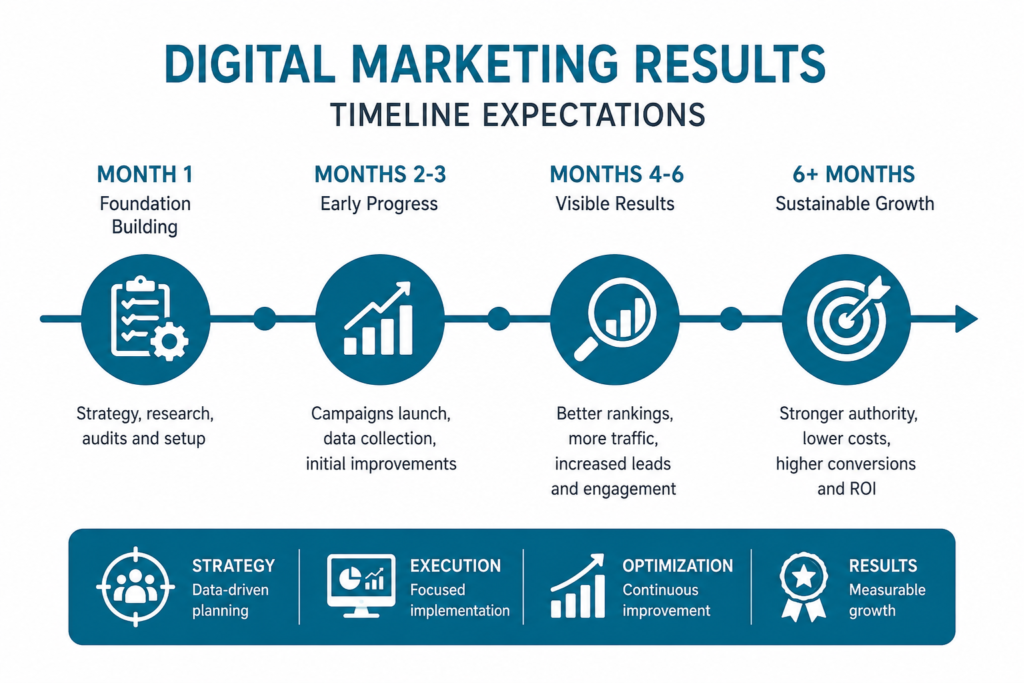
The First 30 Days: Foundation Building
The initial month focuses primarily on preparation rather than aggressive promotion.
Most agencies spend this period:
- Auditing the website
- Installing Google Analytics and tracking tools
- Creating marketing strategies
- Designing creatives
- Building landing pages
- Conducting keyword research
- Setting campaign objectives
Although sales may begin during this stage through paid advertising, substantial growth typically emerges later.
What Happens During Month 2?
During the second month, campaigns begin collecting valuable performance data.
Marketing specialists analyze:
- Click-through rates
- Cost per click
- Conversion rates
- Bounce rates
- Audience engagement
- Search rankings
Campaign adjustments become increasingly data-driven rather than assumption-based.
Businesses often experience gradual increases in website traffic and lead generation during this phase.
What to Expect by Month 3
The third month often represents the turning point.
Marketing agencies have accumulated sufficient data to optimize campaigns effectively.
At this stage, businesses commonly notice:
- Better-quality leads
- Lower advertising costs
- Higher conversion rates
- Improved search visibility
- Increased social engagement
- More consistent website traffic
Momentum begins replacing experimentation.
Results Between Months 4 and 6
Months four through six generally produce the most visible improvements.
SEO pages start ranking.
Content begins attracting organic visitors.
Advertising campaigns become increasingly efficient.
Brand recognition strengthens.
Customer trust improves.
Many businesses begin experiencing predictable lead generation and measurable return on investment.
Growth Beyond Six Months
After six months, digital marketing often enters its compounding phase.
High-performing campaigns continue improving because agencies possess extensive historical performance data.
Businesses frequently experience:
- Higher search rankings
- Lower acquisition costs
- Stronger brand authority
- Better customer retention
- Increased referral traffic
- Greater market credibility
Consistency becomes a significant competitive advantage.
SEO Timeline Expectations
SEO requires patience because search engines need time to evaluate website quality and authority.
Typical expectations include:
Month 1–2
- Technical improvements
- Keyword planning
- Content creation
Month 3–4
- Ranking improvements
- Increased impressions
Month 5–6
- Organic traffic growth
- Higher keyword visibility
Month 6–12
- Significant lead generation
- Strong domain authority
- Sustainable traffic growth
SEO rewards persistence rather than shortcuts.
Google Ads Performance Timeline
Google Ads produces faster outcomes than SEO.
Typical progression includes:
Week 1
Campaign launch and initial data collection.
Weeks 2–4
Keyword optimization.
Audience refinement.
Bid adjustments.
Month 2
Improved conversion rates.
Lower cost per acquisition.
Month 3
Stable performance with predictable lead generation.
Meta Ads Performance Timeline
Meta advertising benefits from continuous optimization.
Typical progression:
Week 1:
Learning phase.
Weeks 2–4:
Audience testing.
Creative optimization.
Month 2:
Better engagement.
Lower advertising costs.
Month 3:
Consistent lead flow and scalable campaigns.
Content Marketing Timeline
Content marketing compounds over time.
Early articles establish authority.
Later articles begin ranking for competitive keywords.
Quality content can continue generating traffic for years without additional advertising spend.
Most businesses observe meaningful content marketing results between four and eight months.
Social Media Marketing Timeline
Social media success depends on consistency rather than virality.
Businesses generally experience:
First Month:
Brand awareness.
Months 2–3:
Growing engagement.
Months 4–6:
Community development.
Months 6+:
Lead generation and customer loyalty.
Authentic interaction consistently outperforms sporadic posting.
Email Marketing Timeline
Email marketing produces relatively quick outcomes once subscriber lists are established.
Businesses often notice:
- Higher repeat purchases
- Improved customer retention
- Better engagement
- Increased conversions
Well-crafted email automation continues generating revenue long after initial setup.
Local SEO Timeline
Local businesses frequently experience quicker SEO improvements because competition is often geographically limited.
Timeline expectations include:
Months 1–2:
Google Business Profile optimization.
Citation improvements.
Months 3–4:
Local keyword rankings improve.
Months 5–6:
Higher map visibility.
Increased phone calls.
More walk-in customers.
Website Optimization and Conversion Improvements
Generating traffic alone does not guarantee sales.
Marketing agencies also optimize websites by improving:
- Landing pages
- Navigation
- Mobile responsiveness
- Page speed
- Call-to-action placement
- Contact forms
- User experience
Small adjustments frequently produce substantial improvements in conversion rates.
Common Reasons Results May Take Longer
Certain obstacles naturally delay marketing success.
Examples include:
- Poor website performance
- Extremely competitive industries
- Limited advertising budgets
- Weak branding
- Inconsistent communication
- Low-quality content
- Frequent strategy changes
Understanding these challenges prevents unrealistic expectations.
Signs Your Marketing Agency Is Making Progress
Positive indicators often appear before dramatic revenue growth.
Look for:
- Rising website traffic
- Better keyword rankings
- Increasing engagement
- Lower advertising costs
- Higher conversion rates
- More qualified inquiries
- Improved customer feedback
These metrics indicate healthy campaign development.
Realistic KPIs to Track
Instead of focusing solely on revenue, businesses should monitor comprehensive performance indicators.
Useful KPIs include:
- Organic traffic
- Click-through rate
- Conversion rate
- Cost per lead
- Return on ad spend
- Customer acquisition cost
- Lead quality
- Search rankings
- Website engagement
- Revenue growth
Balanced measurement provides a clearer understanding of campaign performance.
Mistakes Businesses Make While Waiting for Results
Many companies interrupt successful campaigns before they mature.
Common mistakes include:
- Expecting immediate SEO rankings
- Changing agencies too quickly
- Frequently redesigning campaigns
- Ignoring analytics
- Reducing budgets prematurely
- Comparing different industries unfairly
Patience and consistency often outperform constant experimentation.
How to Accelerate Marketing Success
Businesses can improve timelines by actively collaborating with their agency.
Helpful strategies include:
- Providing timely feedback
- Investing in quality content
- Improving customer service
- Responding quickly to leads
- Maintaining consistent branding
- Increasing advertising budgets strategically
- Monitoring analytics regularly
Marketing performs best when both the agency and business work together.
Choosing the Right Agency for Sustainable Growth
A reliable agency emphasizes long-term business growth rather than unrealistic promises.
Characteristics of trustworthy agencies include:
- Transparent reporting
- Data-driven decision-making
- Ethical marketing practices
- Regular communication
- Continuous optimization
- Strategic planning
- Industry expertise
Sustainable success is built through consistency, not shortcuts.
Frequently Asked Questions
Can digital marketing produce results in one month?
Paid advertising can generate traffic and leads within weeks. SEO and content marketing generally require several months before significant improvements appear.
Is SEO slower than paid advertising?
Yes. SEO builds long-term organic visibility, while paid advertising generates immediate exposure through budget allocation.
How often should campaign performance be reviewed?
Monthly reviews provide sufficient data for meaningful optimization while avoiding unnecessary changes based on short-term fluctuations.
Should businesses stop campaigns if results are slow?
Not necessarily. Performance should be evaluated using multiple KPIs, strategic objectives, and long-term trends before making major decisions.
Conclusion
Digital marketing success is rarely instantaneous, but it is highly rewarding when approached with realistic expectations and strategic consistency. Paid advertising can begin delivering measurable outcomes within weeks, while SEO, content marketing, and brand-building initiatives often require several months before reaching full potential. The most successful businesses understand that sustainable growth emerges from continuous optimization, informed decision-making, and a long-term commitment to improvement.
Rather than expecting overnight transformation, organizations should focus on measurable progress, meaningful engagement, and incremental gains that compound over time. By partnering with a capable digital marketing agency, monitoring the right performance indicators, and maintaining a collaborative approach, businesses can build a resilient digital presence that generates qualified leads, strengthens brand authority, and delivers lasting return on investment.