
Introduction:
Choosing the Right Digital Marketing Partner
Digital marketing has become an indispensable component of modern business growth. Whether the goal is to increase website traffic, generate qualified leads, improve search engine rankings, or establish a recognizable brand, selecting the right marketing partner significantly influences long-term success.
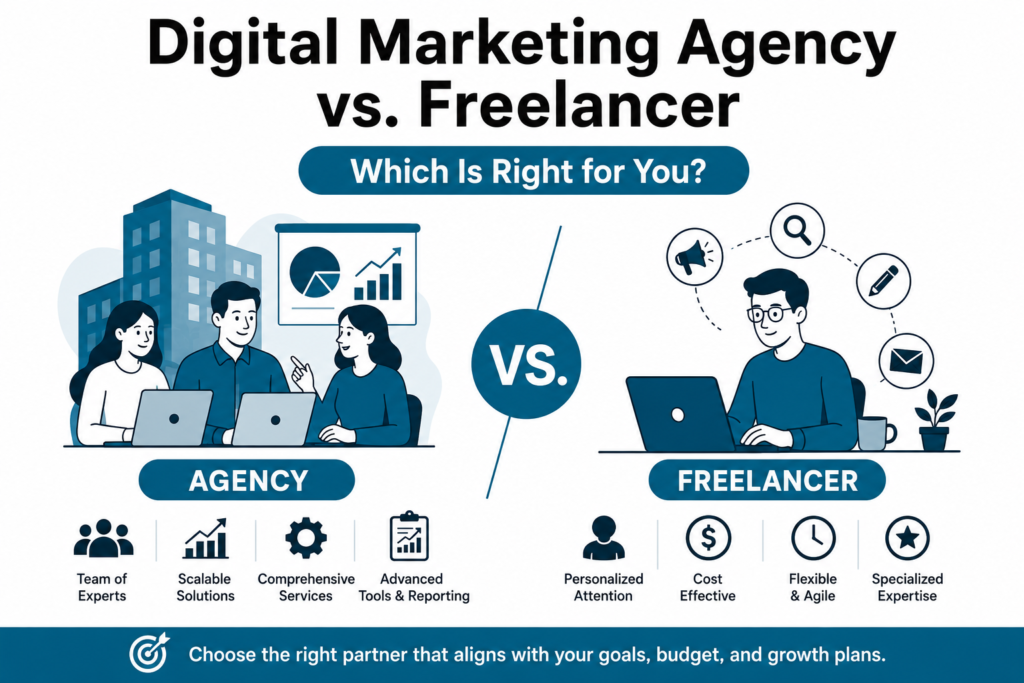
One of the most common decisions businesses face is choosing between a digital marketing agency and a freelancer. Both offer valuable expertise, but they differ considerably in pricing, capabilities, scalability, communication, and overall business impact.
Understanding these distinctions helps organizations invest wisely and maximize their marketing return on investment.
Understanding the Role of a Digital Marketing Agency
What Is a Digital Marketing Agency?
A digital marketing agency is a company composed of specialists working together across multiple marketing disciplines. Instead of relying on a single individual, agencies employ dedicated professionals for SEO, PPC advertising, content marketing, graphic design, video production, social media management, email marketing, analytics, and web development.
This collaborative ecosystem enables agencies to deliver comprehensive marketing strategies.
Core Services Offered by Agencies
Most agencies provide:
- Search Engine Optimization (SEO)
- Google Ads Management
- Meta Ads Campaigns
- Social Media Marketing
- Website Development
- Content Marketing
- Email Marketing
- Conversion Rate Optimization
- Analytics Reporting
- Branding and Creative Design
These integrated services allow businesses to maintain consistency across every digital channel.
Understanding the Role of a Digital Marketing Freelancer
What Is a Freelancer?
A freelancer is an independent marketing professional who provides specialized services directly to clients. Freelancers typically possess expertise in one or several marketing disciplines and work remotely on project-based or monthly retainers.
Their lean structure enables greater flexibility and personalized communication.
Services Typically Provided
Freelancers commonly offer:
- SEO
- Social Media Management
- Google Ads
- Graphic Design
- Content Writing
- Email Marketing
- Website Maintenance
Many freelancers specialize deeply in one field rather than offering end-to-end marketing services.
Agency vs. Freelancer: Key Differences at a Glance
| Feature | Agency | Freelancer |
|---|---|---|
| Team Size | Multiple Experts | Single Professional |
| Cost | Higher | Lower |
| Scalability | Excellent | Limited |
| Communication | Structured | Direct |
| Services | Comprehensive | Specialized |
| Resources | Advanced | Moderate |
| Project Capacity | Large | Small to Medium |
| Backup Support | Available | Usually Limited |
Cost Comparison
Agency Pricing
Agencies generally charge higher fees because businesses gain access to an entire team of professionals, premium software subscriptions, dedicated account managers, and sophisticated reporting systems.
Monthly retainers often range from moderate to enterprise-level pricing depending on project complexity.
Advantages
- Complete marketing support
- Premium tools included
- Multiple specialists involved
Freelancer Pricing
Freelancers usually operate with lower overhead costs, making them considerably more affordable.
Businesses can hire freelancers for individual projects, hourly assignments, or monthly retainers without committing to extensive contracts.
Advantages
- Budget-friendly
- Flexible pricing
- Ideal for startups
Expertise and Skill Sets
Agencies combine specialists from diverse disciplines, allowing every aspect of a campaign to be handled by professionals with focused expertise.
Freelancers, while highly skilled, may have limitations outside their core specialization.
For example, an SEO freelancer might excel at keyword optimization but may not possess advanced video editing or branding capabilities.
Team Strength vs. Individual Talent
Agencies distribute responsibilities among dedicated experts.
One professional develops strategy.
Another creates content.
Another manages paid advertising.
Another analyzes campaign performance.
This collaborative methodology reduces errors and improves efficiency.
Freelancers rely entirely on personal expertise, making consistency dependent on one individual’s workload and experience.
Scalability and Business Growth
As businesses expand, marketing requirements become increasingly complex.
Agencies can quickly allocate additional designers, strategists, developers, and advertising specialists without disrupting ongoing campaigns.
Freelancers often reach capacity limits, making rapid scaling more challenging.
Communication and Project Management
Most agencies utilize professional project management platforms, scheduled meetings, reporting dashboards, and dedicated account managers.
Freelancers typically provide more direct communication through email, messaging applications, or video calls.
Some businesses appreciate the personalized interaction, while others prefer the structured processes agencies provide.
Availability and Turnaround Time
Agencies generally maintain predictable workflows because multiple team members can work simultaneously.
If one employee is unavailable, another usually assumes responsibility.
Freelancers may experience delays due to illness, vacations, or overlapping client commitments.
Technology, Tools, and Resources
Marketing agencies invest heavily in enterprise-grade platforms including:
- SEO software
- Analytics platforms
- Competitor research tools
- Heat mapping software
- CRM integrations
- Marketing automation
- AI-assisted reporting
Freelancers may use excellent tools as well, but budget constraints can limit software access.
Creativity and Innovation
Creativity thrives through collaboration.
Agencies often conduct brainstorming sessions where designers, marketers, writers, and strategists contribute diverse ideas.
Freelancers bring originality shaped by personal experience and often deliver highly customized creative solutions.
Both approaches can produce exceptional campaigns depending on the project.
Quality Control and Consistency
Most agencies implement multiple review stages before publishing campaigns.
Designs, advertisements, and content typically undergo editorial reviews, technical verification, and performance analysis.
Freelancers generally perform their own quality checks, making outcomes heavily dependent on individual discipline.
Flexibility and Customization
Freelancers frequently adapt quickly to changing client requests.
Without extensive internal procedures, modifications can often be completed rapidly.
Agencies may require formal approvals and workflow adjustments, although this often results in greater consistency.
Accountability and Reliability
Agencies generally operate under formal contracts, service-level agreements, documented processes, and dedicated support teams.
Freelancers build their reputation through personal relationships and client satisfaction.
Selecting experienced professionals with verified portfolios minimizes potential risks in either model.
Industry Experience and Specialization
Some agencies specialize in industries such as:
- Healthcare
- Real Estate
- E-commerce
- Education
- Manufacturing
- Hospitality
Likewise, freelancers often establish expertise within specific niches, allowing them to understand industry trends and customer behavior exceptionally well.
When a Freelancer Is the Better Choice
Hiring a freelancer makes sense when:
- Budget is limited.
- Only one marketing service is required.
- Short-term projects need completion.
- Personalized communication is preferred.
- Startup marketing requirements remain relatively simple.
For small businesses, freelancers often provide remarkable value.
When a Digital Marketing Agency Is the Better Choice
Agencies become the ideal choice when businesses require:
- Multi-channel marketing
- Large advertising budgets
- Branding initiatives
- Website development
- Marketing automation
- Team collaboration
- Long-term strategic planning
- Comprehensive reporting
Growing businesses often benefit significantly from agency support.
Hybrid Model: Combining Agencies and Freelancers
Many successful organizations combine both service models.
An agency may oversee the complete marketing strategy while freelancers contribute specialized skills such as animation, technical writing, photography, or video editing.
This hybrid model balances cost efficiency with professional scalability.
Common Myths About Agencies and Freelancers
Myth 1: Agencies Are Always Better
Reality: Agencies excel at comprehensive marketing, but freelancers can outperform agencies in specialized tasks.
Myth 2: Freelancers Are Less Professional
Reality: Many freelancers possess years of agency experience and maintain exceptional standards.
Myth 3: Agencies Are Too Expensive
Reality: Agencies often generate higher returns by integrating multiple marketing channels effectively.
Myth 4: Freelancers Cannot Handle Large Projects
Reality: Experienced freelancers frequently collaborate with other independent professionals to manage larger assignments.
Factors to Consider Before Making a Decision
Evaluate the following before hiring:
- Business objectives
- Budget
- Marketing complexity
- Timeline
- Internal resources
- Required expertise
- Long-term growth plans
- Reporting expectations
Making decisions based solely on price rarely delivers optimal results.
Questions to Ask Before Hiring
Before selecting an agency or freelancer, ask:
- What industries have you worked with?
- Can you share measurable case studies?
- Which tools do you use?
- How will success be measured?
- What reporting schedule do you follow?
- Who will handle my account?
- What is included in the pricing?
- How do you manage revisions and communication?
Clear answers build confidence and reduce misunderstandings.
Real-World Scenarios
Startup
A new business launching its first website and social media presence may benefit from hiring a freelancer for affordable, focused support.
Growing Business
A company expanding into paid advertising, SEO, email marketing, and content creation often requires the coordinated expertise of a digital marketing agency.
Enterprise Brand
Large organizations managing multiple campaigns across regions usually depend on agencies with specialized teams, structured processes, and enterprise-level reporting capabilities.
Pros and Cons Comparison Table
| Digital Marketing Agency | Freelancer |
|---|---|
| Full-service solutions | Lower cost |
| Team expertise | Personalized attention |
| Better scalability | Flexible engagement |
| Advanced reporting | Faster small changes |
| Premium tools | Specialized skills |
| Structured workflow | Direct communication |
| Higher investment | Limited bandwidth |
| Multiple specialists | Depends on one person |
Final Verdict: Which Option Is Right for Your Business?
There is no universal answer to the agency-versus-freelancer debate. The ideal choice depends on your business goals, budget, project complexity, and long-term vision.
A freelancer is an excellent fit for startups, entrepreneurs, and businesses seeking specialized expertise at a lower cost. Their flexibility, affordability, and direct communication make them ideal for focused projects and lean marketing budgets.
A digital marketing agency, on the other hand, is better suited for organizations that require a comprehensive, scalable, and strategic marketing approach. With access to multidisciplinary teams, advanced tools, and integrated campaign management, agencies are well-equipped to support sustained business growth and manage complex marketing initiatives.
Ultimately, the most effective decision is the one that aligns with your current needs while supporting your future ambitions. By carefully evaluating your objectives, available resources, and desired outcomes, you can choose a marketing partner that delivers measurable results and contributes meaningfully to your business success.