
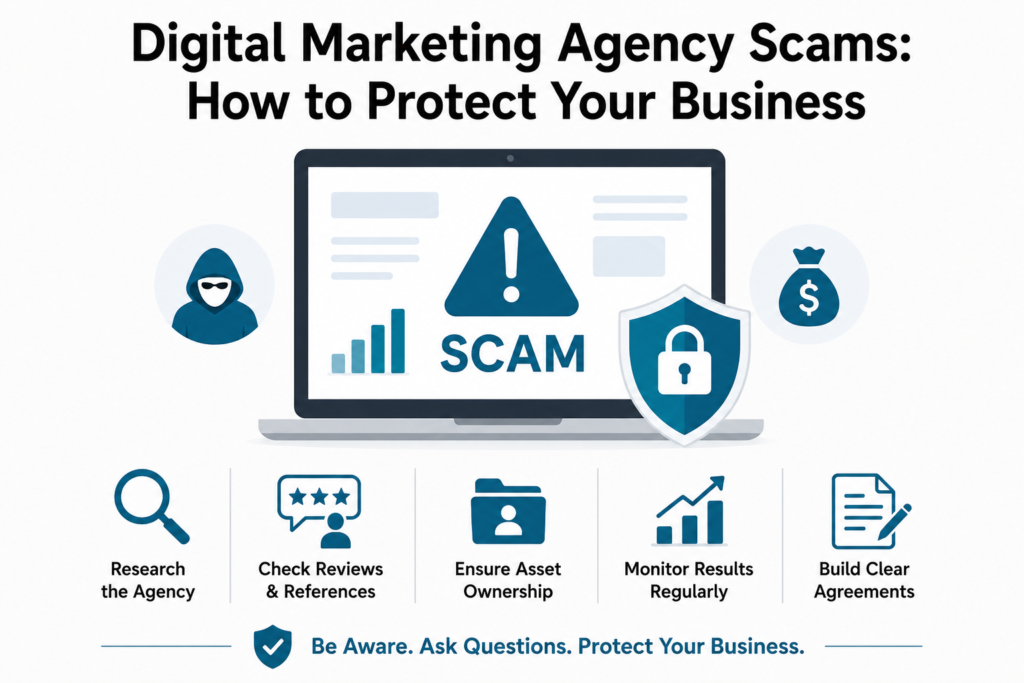
Introduction:The Rising Threat of Digital Marketing Scams
Digital marketing has become an indispensable growth engine for modern businesses. From startups seeking visibility to established enterprises pursuing expansion, organizations increasingly rely on digital channels to generate leads, attract customers, and build brand authority.
However, the rapid growth of the industry has also created opportunities for unethical operators. Fraudulent agencies often prey on business owners who may lack technical marketing expertise. They exploit knowledge gaps, make extravagant promises, and deliver disappointing results.
Understanding how these scams operate is the first step toward protecting your business and safeguarding your marketing investment.
Understanding Digital Marketing Agency Fraud
Agency fraud occurs when a marketing provider intentionally misrepresents services, results, expertise, or performance to secure and retain clients.
Not every underperforming campaign is fraudulent. Marketing outcomes can vary due to competition, market conditions, and customer behavior. Fraud becomes evident when agencies deliberately conceal information, manipulate data, or make promises they know cannot be fulfilled.
These deceptive practices can drain budgets, damage reputations, and delay business growth for months or even years.
Unrealistic Promises and Guaranteed Results
One of the most prevalent warning signs is the promise of guaranteed outcomes.
Search engines such as Google continuously update their algorithms. No agency can legitimately guarantee a number-one ranking for competitive keywords. Similarly, no marketing company can promise a specific volume of leads or sales without considering market variables.
Fraudulent agencies often leverage these guarantees to attract clients seeking rapid growth. They present marketing as a certainty rather than a strategic process.
Businesses should view absolute guarantees with skepticism. Reputable agencies focus on measurable improvement rather than impossible assurances.
Lack of Transparency in Reporting
Transparency is the foundation of a trustworthy marketing relationship.
Some agencies provide vague reports filled with vanity metrics that appear impressive but offer little business value. Others deliberately withhold critical performance data to obscure poor results.
A particularly concerning practice involves refusing client access to advertising accounts, analytics platforms, or campaign dashboards. This creates dependency and prevents businesses from independently verifying performance.
Legitimate agencies encourage transparency and provide unrestricted access to relevant marketing data.
Fake Case Studies and Fabricated Testimonials
Success stories are valuable indicators of expertise, but not all testimonials are authentic.
Some agencies create fictional case studies or exaggerate campaign outcomes. Others use stock photography and fabricated client identities to manufacture credibility.
Before engaging an agency, businesses should verify references whenever possible. Request direct conversations with past clients. Review independent feedback sources and examine whether case studies contain detailed, verifiable information.
Authenticity often reveals itself through specificity and consistency.
Ownership Issues with Digital Assets
Many businesses overlook digital asset ownership until problems emerge.
Some agencies register websites, domains, advertising accounts, or social media profiles under their own control rather than the client’s. This creates significant risk if the relationship deteriorates.
A business should always maintain ownership of its website, domain registration, analytics accounts, advertising platforms, and social media properties. Agencies should receive administrative access rather than ownership rights.
Retaining control ensures continuity and protects valuable digital assets.
Hidden Fees and Contract Traps
Unclear pricing structures often conceal financial surprises.
Certain agencies advertise attractive monthly rates but introduce additional charges for reporting, content creation, campaign adjustments, or platform management. Others lock businesses into lengthy contracts with restrictive cancellation clauses.
Before signing any agreement, carefully review fee structures, contract duration, renewal conditions, and termination requirements.
Transparency in pricing reflects professionalism and integrity.
Black Hat Marketing Practices
Ethical marketing focuses on sustainable growth. Fraudulent agencies frequently prioritize shortcuts.
Black hat SEO tactics may include keyword stuffing, hidden content, automated link schemes, and spam backlinks. Social media fraud can involve purchased followers, fake engagement, and bot-generated interactions.
While these methods may produce temporary results, they often trigger search engine penalties, reduced visibility, and long-term reputational damage.
Businesses should prioritize agencies that adhere to ethical and industry-approved marketing practices.
Red Flags to Watch Before Hiring an Agency
Several warning signs frequently appear before problems arise.
Poor communication is a significant indicator. Agencies that avoid direct answers or provide vague explanations may lack expertise or transparency.
Generic proposals are another concern. Effective marketing requires customization. An agency that offers identical strategies to every client may not understand your business needs.
Reluctance to discuss methodology, reporting procedures, or performance expectations should also raise concerns.
Trustworthy agencies welcome questions and provide detailed responses.
Due Diligence Before Signing a Contract
Comprehensive research can prevent costly mistakes.
Examine the agency’s website, leadership team, client portfolio, and online presence. Assess whether their marketing reflects the quality they promise to deliver.
Request examples of previous work. Evaluate reporting samples. Ask how performance is measured and how success is defined.
Critical questions often reveal the difference between experienced professionals and opportunistic sales organizations.
Building Fraud Prevention Systems
Fraud prevention should be an ongoing process rather than a one-time activity.
Establish regular performance reviews. Monitor campaign metrics independently through analytics platforms. Maintain ownership and access to all digital assets.
Periodic audits can identify inefficiencies, inconsistencies, or potential misconduct before significant damage occurs.
Strong oversight creates accountability and reduces vulnerability.
Creating a Safe Agency Partnership
The most successful agency relationships are built on mutual transparency and clearly defined expectations.
Businesses should establish measurable Key Performance Indicators (KPIs) from the outset. Objectives may include website traffic growth, lead generation, conversion rates, return on advertising spend, or customer acquisition metrics.
Regular communication ensures alignment and enables continuous optimization.
A collaborative partnership produces stronger results than a transactional arrangement.
Conclusion: Protecting Your Business from Marketing Fraud
Digital marketing can be one of the most powerful growth investments a business makes. Yet the presence of fraudulent agencies underscores the importance of vigilance.
Protecting your business requires careful research, transparent agreements, ethical partners, and ongoing monitoring. By recognizing common scams and implementing effective fraud prevention strategies, organizations can avoid costly mistakes and build productive marketing relationships.